
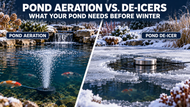
Pond Aeration vs De-Icers What Your Pond Needs Before Winter
Sep 22nd 2026
Pond Aeration vs De-Icers What Your Pond Needs Before Winter
When cold weather arrives, pond owners often ask the same question: Do I need an aerator, a pond heater or both?
The answer depends on the pond, but the first step is understanding that these products do different jobs. A pond aeration system moves air through the water and supports oxygen exchange. A pond de-icer uses heat to help maintain an opening at the surface. Neither product is intended to heat the entire pond.
Preparing this equipment before the first hard freeze is much easier than trying to solve a problem after the pond has already iced over.
Why winter conditions can become a problem
As water cools, fish activity and feeding slow down. The pond may look quiet, but biological activity continues. Fish still respire, and organic material such as leaves, algae and dying plants continues to break down.
When ice and snow cover the surface for an extended period, the pond has less contact with the atmosphere and receives less sunlight. That can reduce oxygen production and allow gases from respiration and decomposition to accumulate beneath the ice. Maintaining gas exchange becomes especially important in ponds with fish, heavy organic debris or long periods of ice cover.
What pond aeration does in winter
A pond aeration system uses an air pump, airline and diffuser to introduce bubbles and move water. During cold weather, this movement can support oxygen exchange and help keep a small area near the surface from sealing completely.
Aeration is valuable throughout the year, but winter placement deserves special attention. In many fish ponds, the deepest water remains slightly warmer than the water near the surface. Placing a diffuser in a shallower area during winter can support gas exchange without aggressively circulating the entire deepest zone.
Every pond is different. Follow the equipment manufacturer's directions and consider the pond's depth, shape, fish load and local winter conditions when choosing the diffuser location.
What a pond de-icer does
A pond heater or de-icer is designed to maintain an opening in surface ice. It is not intended to warm the entire pond or keep all of the water ice-free.
That opening allows gases to escape and oxygen to continue entering the water. Thermostatically controlled models operate only when needed, helping reduce unnecessary energy use compared with a unit that runs continuously.
Choose a model rated for outdoor pond use, follow its installation instructions and inspect the cord and housing before the season begins. Never use an indoor heater or an improvised heating device in a pond.
Do you need aeration a de-icer or both
For many backyard fish ponds in freezing climates, using aeration and a de-icer together provides a practical layer of protection. The aerator supports water movement and oxygen exchange, while the de-icer helps maintain a dependable opening during colder stretches.
Aeration may be enough when winters are moderate and the system consistently maintains an opening near the surface.
A de-icer may be helpful when prolonged freezing can close the opening created by aeration.
Both may be appropriate for fish ponds exposed to sustained cold, heavy snow cover or repeated freeze and thaw cycles.
Larger ponds and lakes require equipment sized and positioned for their depth, surface area and specific management goals.
No single setup is correct for every pond. The goal is not to prevent all ice. The goal is to maintain appropriate gas exchange while protecting the fish and equipment through winter.
Choose and prepare the equipment early
Whatever setup you choose, prepare it before the first hard freeze. Check the air pump, airline and diffuser for normal operation, and move the diffuser to the manufacturer's recommended winter position. Inspect and test the de-icer according to its instructions, including the cord, housing and outdoor electrical connection.
If an opening closes during severe weather, avoid striking or chopping the ice. The shock and vibration can disturb fish, and working on an icy pond creates an unnecessary safety risk.
The simple answer
Aeration supports oxygen exchange and water movement. A de-icer helps maintain an opening in the ice. If aeration alone keeps a reliable opening during your typical winter, it may be enough. If prolonged freezing can close that opening, adding a de-icer provides another layer of protection.
Pond Warehouse carries pond aeration kits, heaters and de-icers and fall seasonal pond supplies to help you choose the right cold-weather setup for your pond.